Successful 3D Subsurface Mapping of Embedded Massive Sulfides (Ishizu et al., 2024, Geophysics)

Ishizu, K. Kasaya, T., Goto, T. N., Koike, K., Siripunvaraporn, W., Iwamoto, H., … & Ishibashi, J. I. (2024). A marine controlled-source electromagnetic application using towed and seafloor-based receivers capable of mapping seafloor and embedded massive sulfides. Geophysics, 89(3), E87-E99.
Point 1: Successful 3D subsurface mapping of embedded massive sulfides
Conventional marine electromagnetic methods for deep-sea metallic deposit exploration involved towing cables with current transmitters and receivers. While this allowed for mapping massive sulfides on the seafloor (mound-type seafloor massive sulfides), it was difficult to detect anomalies buried beneath the seafloor (embedded seafloor massive sulfides).
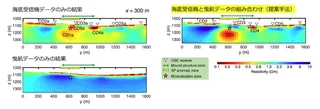
In this paper, we developed a system that combines the aforementioned towed system with multiple seafloor-based electric and magnetic field receivers. We demonstrated its effectiveness for simultaneously exploring embedded anomalies through numerical simulations and real-world data. Since embedded seafloor massive sulfides are highly promising as resources but lacked established exploration methods, the development of this technique represents a breakthrough in deep-sea metallic deposit exploration. Applying this method to various hydrothermal fields in the future may lead to more accurate resource assessments.
